

Skip to content
Introducing AgentMux v0 · Alpha

The deterministic
agentic pipeline.

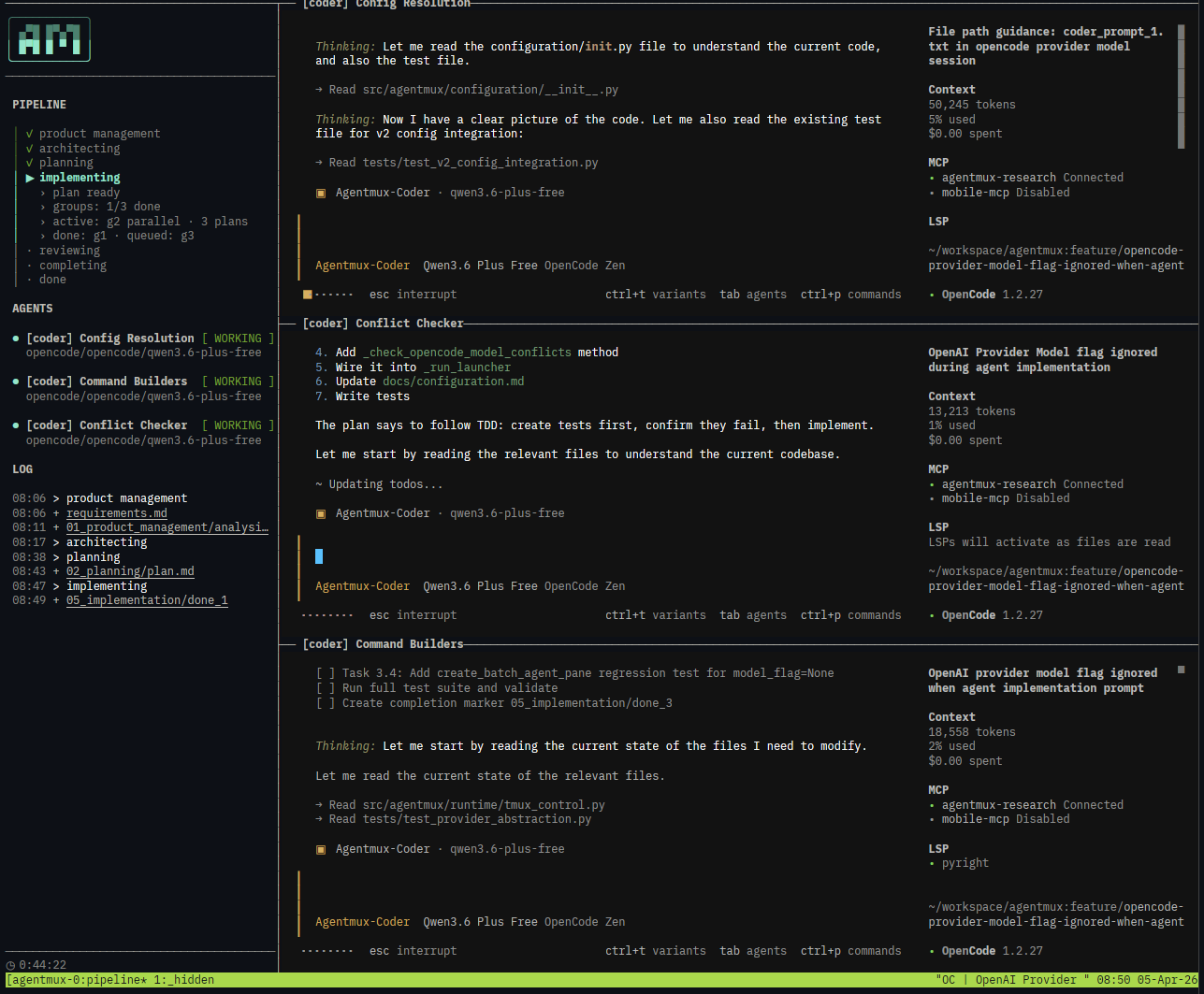
AgentMux orchestrates a deterministic multi-agent workflow for end-to-end software development. It drives the AI CLIs you already use — Claude, Codex, Copilot, Cursor, Gemini, OpenCode, Qwen — through tmux, reusing your existing subscriptions instead of paying per token.

AgentMux tmux session — monitor pane on the left, agent panes on the right running claude, codex, gemini
▸ CLI providers
7 bridges
claude · codex · copilot · cursor · gemini · opencode · qwen
Capabilities

Architectural Logic

Phase state machine

A deterministic state machine moves work through product_management → architecting → planning → designing → implementing → reviewing → completing. Every transition is driven by structured events, never by artifact sniffing.

STATE_MACHINEEVENT_BUSPHASE_HANDLERS

Structured handoffs

Each phase hands off through MCP-validated contracts — no freeform drift between architect, planner, coder, and reviewer.

MCP_HANDOFF
>_

CLI first

No bespoke runtime, no proprietary harness. AgentMux drives the existing CLIs you already authenticated against — claude, codex, copilot, cursor, gemini, opencode, qwen — through tmux key injection, reusing your subscriptions.

NO_API_COSTSTMUX_NATIVE

Bounded review loop

The reviewing phase fans out into logic, quality, and expert reviewers. A single pass/fail verdict either promotes the work to completing or sends it back through fixing — bounded by an explicit loop cap.

REVIEW_LOOPVERDICT_PASS_FAIL
Quickstart

Three commands to a deterministic pipeline.

  1. 01

    Install

    Pull the AgentMux CLI as an isolated tool with pipx. It exposes the agentmux command everywhere.

    pipx install git+https://github.com/markuswondrak/AgentMux.git
  2. 02

    Initialise the project

    Scaffold the .agentmux/ directory in your repo. The interactive wizard configures providers per role.

    cd your-repo && agentmux init
  3. 03

    Run the pipeline

    Hand AgentMux a feature description. It opens a tmux session and drives the workflow end-to-end.

    agentmux "Add rate limiting to the API"
Architecture · the closed event loop

A tmux-based orchestration kernel.

Existing CLI agents (claude, codex, copilot, cursor, gemini, opencode, qwen) are driven by keystroke events injected into tmux panes. Agents never talk to each other — the orchestrator mediates exclusively through the file system and a shared event bus. The blue line marks the closed event loop.

entry

pipeline.application

CLI entry, launcher, --orchestrate mode.

config

configuration

Four layers: defaults → user → project → CLI.

sessions

state_store

Creates & resumes feature sessions. state.json holds the phase.

core

workflow.orchestrator

Routes events to phase handlers, drives the state machine, builds prompts lazily and dispatches them to the right pane.

mcp

mcp_server

Research dispatch and submit tools. Writes tool events to jsonl.

events

event bus

  • FileEventSource — watchdog
  • ToolCallEventSource — jsonl tail
  • InterruptionEventSource — pane poll
handlers

phase handlers

architecting · planning · designing · implementing · reviewing (∥) · fixing · completing

runtime

tmux_control

Pane lifecycle. send_prompt() injects "Read /path/prompt.md".

render

monitor.render

ANSI status rendering for the control pane.

session

tmux session

Monitor pane left, agent panes right. Each pane hosts a CLI: claude · codex · copilot · cursor · gemini · opencode · qwen.

artifacts

.agentmux/.sessions/<feature>

  • state.json · created_files.log
  • 01_product · 02_arch · 03_plan · 04_research · 05_design …
  • tool_events.jsonl
Supported Providers

Mix and match per role.

claude
codex
copilot
cursor
gemini
opencode
qwen
▸ Open source

Run a deterministic pipeline today.

AgentMux is open source on GitHub. Install it with pipx, point it at a repo, and drive your existing CLI subscriptions through a structured multi-agent workflow.

Released under the MIT License.